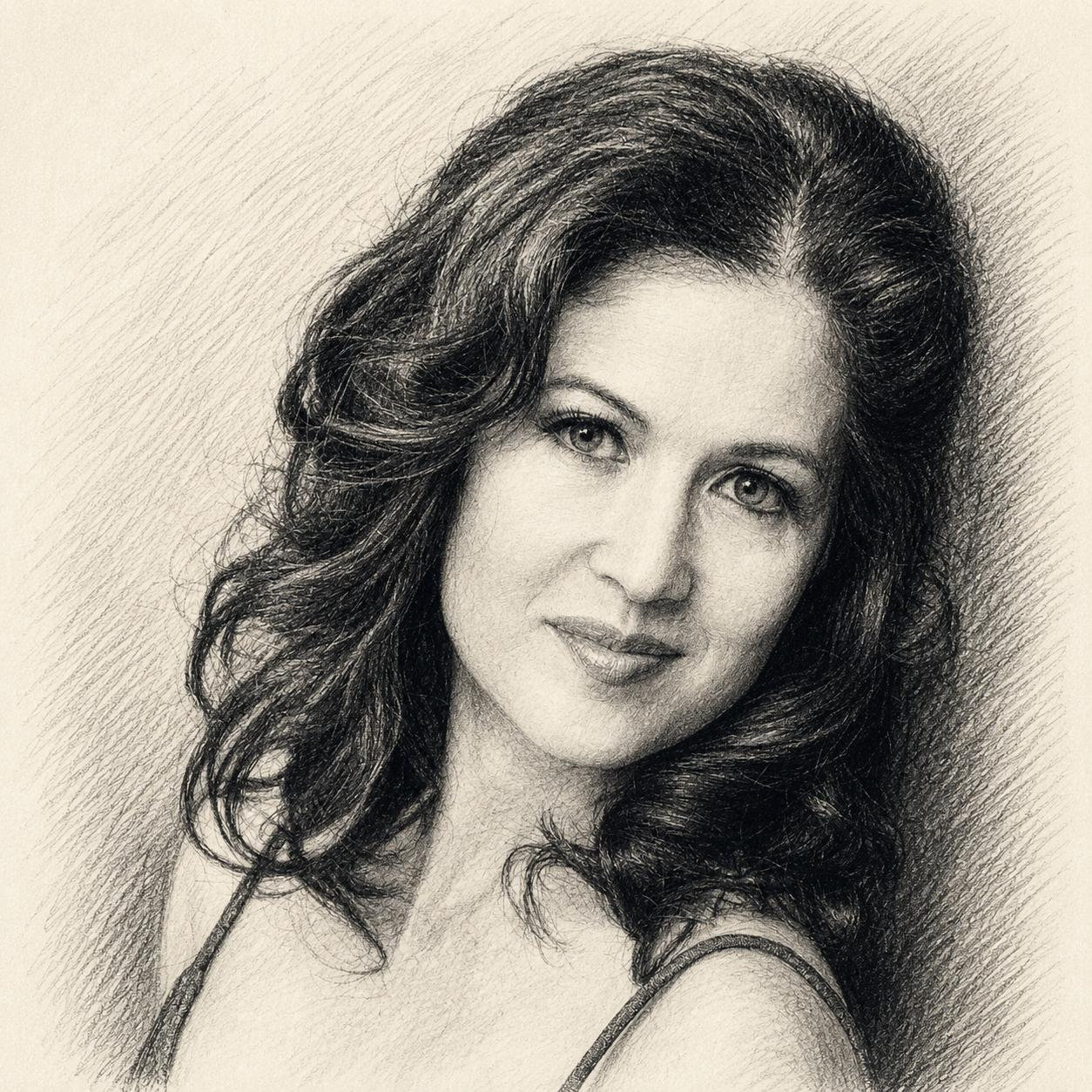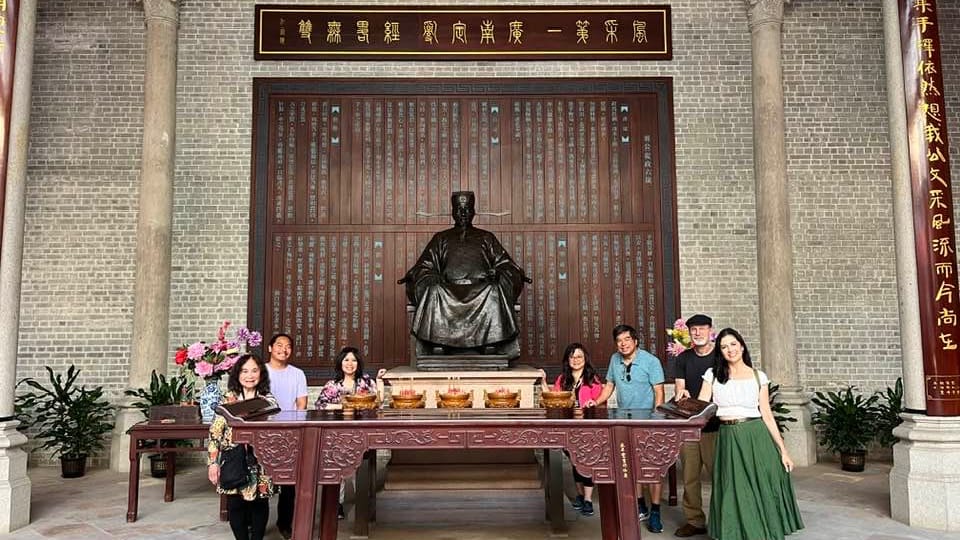
The woman walking into the village was 98 years old. She had last seen it when she was 18. Karin Kim Jensen had come with her aunt to a place she herself had never lived, yet somehow knew: a village assembled in her imagination from decades of family stories—the houses, the fish pond, the altar, the rhythms of ordinary life.
Almost as soon as they entered, a middle-aged man approached on a moped. Their guide explained that the elderly woman beside them had lived there 80 years earlier and had returned to show her family where she came from. Remarkably, much of what they had come looking for was still there. The houses remained. So did the pond and the altar. Even the village layout was recognizable. The China Karin had known only through her mother’s memories had become a physical place beneath her feet.
“These mythical stories became real.”
That moment had been decades in the making. Karin grew up in the San Francisco Bay Area in what she calls a comfortable, almost “very vanilla” American childhood. Her mother’s childhood could hardly have been more different. She had grown up partly in her father’s Chinese laundry in Detroit, later lived in a village in China during the Sino-Japanese War, and returned to the United States alone as a teenager. In California, she survived as a live-in domestic worker and waitress.
As a girl, Karin listened to those stories with fascination. They felt almost mythological, not because she doubted them, but because they seemed so far removed from the life she knew. What stayed with her was the astonishingly short distance between those two worlds. How, she wondered, could so much change in a single generation?
She began thinking about recording her mother’s story while she was still in college. In 2002, shortly after she married, her husband took a job in New Zealand. With an unusual stretch of time alone, Karin finally began. She interviewed her mother extensively, then her aunts and uncle, father and siblings, and later began writing rough chapters while on sabbatical in New Zealand.
Those interviews became the foundation for The Strength of Water: An Asian American Coming of Age Memoir, Karin’s account of her mother’s transpacific life. The book preserves the large events—migration, war, poverty, work—but its power comes from the smaller details around them: the things a family remembers that an official record rarely does.
“History isn’t just about the big grand people. It’s about all of us.”
A document can tell you where someone lived or when she crossed an ocean. It cannot tell you how a baby was cared for in a village without diapers or running water, what a young woman feared, or how a family understood marriage and obligation. Those were the details that made her mother’s world dimensional rather than distant.
One of the customs Karin encountered while reconstructing her mother’s world was an old village wedding ritual. In the days before marriage, a bride would gather with female relatives and friends and speak openly about her regrets, frustrations and grief over the life she was leaving. The women joined her in ritual crying, allowing space for the sadness of leaving one life even as another was about to begin.
Karin had never known the custom herself, and she was fascinated by it. A detail like this brought her closer to understanding the inner life of a culture far removed from the one in which she was raised: how women experienced marriage, departure and the complicated emotions that could accompany a celebration.
Other discoveries were more difficult to absorb. Karin learned that during the Great Depression, when her grandmother had already given birth to two girls and the family was under severe financial strain, her grandfather made a disturbing remark about allowing another newborn daughter to die. Her mother did not believe he intended to act on it, yet she remembered that men of his generation sometimes spoke this way.
Karin wanted to understand where such thinking came from. Her grandfather had been born in nineteenth-century China amid famine, war, natural disasters and extreme insecurity. Her research led her into the history of infanticide across societies facing desperate scarcity. The research did not excuse his words, but it helped her understand the world that had produced them.
Keeping a story does not require carrying everything forward. Some things we carry forward. Others – we understand, and leave behind.
That distinction matters to Karin’s idea of preservation. A family history does not have to be polished into a collection of admirable traditions. Sometimes what deserves to be passed on is the understanding itself: what people faced, why they made certain choices, and how later generations chose differently.
Writing the book preserved what her mother and relatives could tell her. Finding the places inside those stories required another kind of work. Family memory is rarely a complete itinerary. Someone remembers a village but not the road. Someone else remembers a pond, a house, a business or a family name. A story can remain vivid for 70 years while the practical details that would help someone find its location disappear.
For the journey to China, Karin worked with a travel specialist experienced in Chinese ancestral travel. This helped her combine historical and geographic investigation with the fragments she and her relatives had preserved. Slowly, memories that had lived separately began to connect, like pieces in a puzzle.
Then Karin went herself. The journey added something neither oral history nor research could supply. She could stand where the stories had happened, see what survived, understand through her aunt what had changed and bring home her own layer of knowledge. What began as pieces of someone else’s memory became her own experience, her own special route.
She inherited pieces of a map. Memory, research and travel turned them into a path the next generation can follow and add to.
That is what makes an ancestral journey different from simply visiting the country your family came from. You can arrive with an address and see a place. Or you can arrive carrying the story behind it and recognize why an ordinary road, a pond or a village house matters.
Karin has long understood that photographs alone are incomplete containers for travel. She likes to write short observations beside her pictures: whom she met, what they talked about, why she stopped somewhere, what she felt. The grand moments of a journey often survive on their own: an aunt returning after 80 years, a stranger arriving on a moped, the shock of recognizing a place from an old family story. The smaller details are more fragile. The name of a small roadside hotel. The restaurant someone recommended. The guide who knew where to look. The road that led to the village. The stop that almost got skipped. While we are traveling, those details feel impossible to forget. Years later, they are often the first things to blur.
The details that feel incidental today may be exactly what someone else needs in order to follow tomorrow.
That is especially true when a journey carries family history. The useful record is not only proof that we went. It is the route, the discoveries, the people who helped, the places worth returning to and the explanation of why any of it mattered. Preserved together, those details can turn one person’s trip into something another generation can actually re-enter.
Not everything Karin wants to preserve came from her own ancestry. In 1996, years before she formally began writing her mother’s story, Karin joined a historical dance tour through Paris, Prague and Vienna. Her future husband happened to sign up for the same trip.
In Paris, they encountered Carnet de Bals, an organization devoted to preserving nineteenth-century French dances. One evening, as twilight fell, the group danced outdoors carrying lanterns. Karin remembers the darkness, the soft light and the old movements, and thinking how glad she was that someone had decided this unfamiliar tradition was worth keeping.
The trip gave her something else: she and her husband fell in love. Nearly three decades later, historical dance is still part of their marriage. They perform together at events including San Francisco’s Dickens Christmas Fair, while Karin teaches ballet to children at the Alameda Ballet Academy and continues to perform locally herself. A tradition she first encountered as a traveler became part of her own family story.
Sometimes we inherit traditions. Sometimes we encounter them. And sometimes, without realizing it, we build a life around them.
For all that Karin has worked to recover from her family’s past—the stories, the customs, the places—one of the things she carries most deeply from her mother required no research at all. It is a way of understanding family.
Her mother’s name was Yee King Ying. Yee was the family name; King Ying was her individual name. Karin sees meaning in that order. In the Chinese naming convention her mother knew, the family name comes first; in the Western convention, the individual given name leads.
To Karin, that difference gives language to something she absorbed from her mother long before she thought to name it: first we are members of a family, and then we are individuals. She does not offer that as a rule about cultures so much as a truth she recognizes in her own life. Her mother became one of her closest friends, and now, with Karin’s own daughters in college, she sees how deeply that understanding of family has shaped her relationship with them.
First we belong to a family. Then we are individuals.
Karin does not think of raising children as an 18-year undertaking that ends when they leave home. Children grow up, build independent lives and move into worlds of their own, but the family does not become less central. That sense of belonging may be one of the most important values her mother passed to her—and one Karin hopes her daughters will carry without needing to be told that they are carrying it.
Perhaps it also helps explain why Karin went to such lengths to follow her family’s story in the first place. The interviews, the years spent writing The Strength of Water, the research and finally the journey back to China were all acts of family connection across generations. She was not simply looking backward at where her family had been. She was making sure the people who came after her would know what they belonged to.
One of Karin’s daughters has already expressed interest in retracing the family’s route someday. If she does, she will begin with something Karin never had: a path already partly uncovered. She will have her grandmother’s story, her mother’s book, the research that connected family memories to real places, and what Karin learned by making the journey herself.
She can follow that path and add to it. Perhaps she will find a relative no one knew about, discover that a familiar place has changed, or find a better route back to the village. She may remember the hotel worth returning to, the restaurant she loved, or the person who helped her find something she would otherwise have missed. Those details can become part of the family’s knowledge too.
One generation remembers. The next asks questions. Someone does the research. Someone makes the journey. The next generation gets to begin farther along.
Karin began with fragments. By listening, writing, researching and finally traveling, she connected enough of them that her daughter will not have to solve the same puzzle from the beginning. She can start farther along—and someday leave the path clearer for whoever follows her.
Karin Kim Jensen is a Keeper because she refused to let an extraordinary ordinary life disappear. By writing The Strength of Water, she preserved her mother’s journey with the cultural context and intimate details that official history so often misses. By retracing that journey herself, she connected inherited memories to real places. And by sharing what she found, she offers something beyond her own family: an invitation to become curious about where our own stories began. She makes the rest of us wonder what is waiting inside our own family history. What stories we heard but never followed?
Her work reminds us that family history does not have to remain a collection of names, dates and fading photographs. We can ask questions while someone still remembers. We can follow the clues. We can go back. And when we do, we can preserve not only the destination, but the practical path - the people who helped us, the places worth returning to, what we discovered and why it mattered.
Because the best thing we can do with a path worth finding may be to leave it easier for someone else to follow.