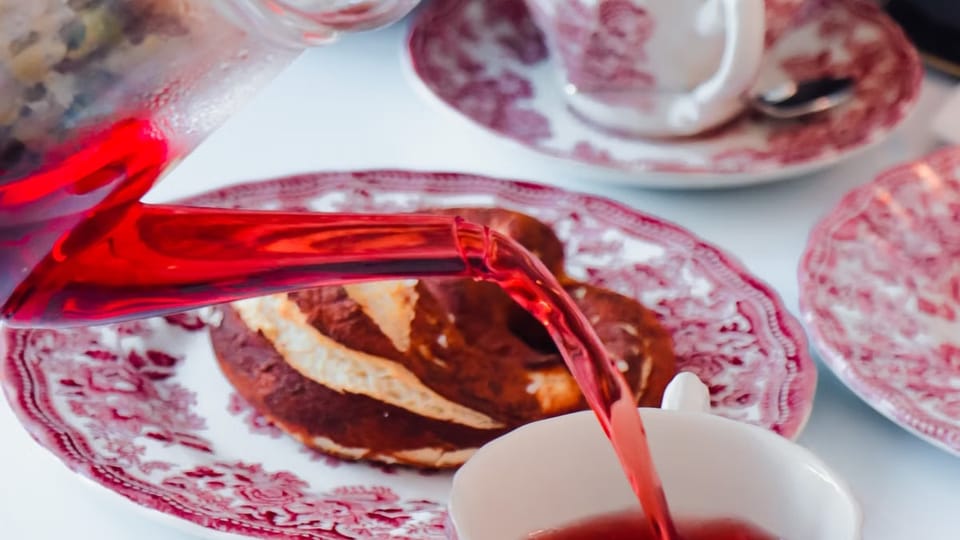
Rain began to fall while Nicole Wilson sat in a tea house in a young farmer’s backyard in Kyotonabe, Japan. He was brewing gyokuro, a carefully cultivated green tea whose leaves are shaded before harvesting. One of her teachers translated as he spoke, but his passion needed little explanation. With the rain pattering on the tin roof, Nicole watched someone share the work he cared deeply about, one cup at a time.
She had traveled to Japan to learn more about tea, after years of writing and teaching about it from home. Yet the feeling of sitting at a table, being offered a cup and someone’s attention, was familiar. Long before she knew the names of Japanese growing regions or Chinese brewing vessels, tea had given her a special place beside her mother at their kitchen table.
Today, Nicole is the award-winning writer and educator behind Tea for Me Please, the blog she began in 2008, and the author of The Tea Recipe Book. Her knowledge reaches into growing methods and the subtleties of flavor, but she wants people to feel comfortable enough to begin wherever they are.
“It’s just leaves and water,” she says. “It can be as simple or as complicated as you want it to be.”
A place at the kitchen table
Her first cups were grocery-store tea bags with milk and sugar, enjoyed in the evening with her mother. As a child, drinking tea felt like a grown-up privilege, a reason to sit together and be included. She doesn’t remember particular conversations as clearly as she remembers how it felt to have that time.
There was another attraction: boxes of Red Rose tea came with little animal figurines, which Nicole loved collecting. Finishing a box meant getting closer to the next animal, a small childhood incentive that still makes her smile.
At college, while classmates drank coffee, she began trying different teas. A flowering tea caught her attention: leaves tied into a ball that opened in water to reveal a flower. The display was enchanting, but the discovery that stayed with her was more basic. Until then, she had never seen loose-leaf tea.
“Wait, there’s whole leaves?” she remembers thinking. That curiosity led her further into tea, eventually becoming years of tasting, writing and helping others discover what they enjoy.
Tea also became a way to come home to herself after demanding days in retail and customer service. She describes arriving home feeling like a ball of stress, then making tea and watching the leaves open as they steeped. The preparation took time, and that time gave her something gentle to focus on.
“It doesn’t solve every problem,” she says, “but it definitely, I think, makes them feel a little bit more doable.”
Following tea to Japan
For years, Nicole wanted to visit a place where tea was grown. Plans begun before the pandemic had been put aside, but the desire remained. As an educator, she felt that seeing tea at its source would deepen what she could share with others.
The opportunity came through the Japanese Tea Master Course with the Global Japanese Tea Association. Nicole says only twelve people were selected for her session, and being accepted made the possibility feel too important to let go. Her employer at the time made clear that she would not be able to take the trip, and she began to question whether it was the right place for her.
With a possible job at a new store awaiting her return, she took the chance and went to Japan, traveling beyond North America for the first time, on her own. She had studied a little Japanese, but navigating an unfamiliar country was still a considerable step outside her comfort zone.
“I can do hard things like that,” she says of what she learned about herself. Her curiosity had brought her somewhere she had long imagined, and she returned with greater confidence in herself.
Japan also challenged her expectations. She had pictured tea leaves and traditional teapots everywhere; instead, she found tea readily available in plastic bottles at convenience stores. Some locals were surprised she had come to study it, and spoke about no longer preparing tea as their parents or grandparents had. She could see how changing lifestyles could loosen the connection to an everyday tradition, even in a country so closely associated with it.
That made her visit to the gyokuro producer especially meaningful. He was a younger farmer committed to a demanding traditional tea at a time when, Nicole explains, the popularity of matcha was encouraging many producers to shift toward making it instead. His commitment gave her a vivid sense of the people and effort behind the tea she wanted to help others understand.
A teapot that has grown with her
One of Nicole’s most meaningful possessions is an unglazed Yixing clay teapot from China, bought online from Seven Cups in Arizona when she was first becoming serious about tea. She has been brewing in it for about eighteen years, returning to a particular oolong she loves, Huang Zhi Xiang.
She explains that the porous clay absorbs tea over time, which is why she reserves the pot for the same kind rather than switching among very different teas. The attachment has grown through use, as the pot has accompanied her learning.
“We’ve both been drinking the same tea together for so many years,” she says.
Keeping tasting notes has allowed her to see changes in herself, too. When she returns to a tea she wrote about early in her blog, she sometimes recognizes familiar impressions, but finds that she can now describe them more precisely. Brewing and tasting, she explains, improve with practice, much like playing the piano or tennis. Everyone begins with their senses; experience helps them notice more.
She also brings that knowledge to a small tea pop-up in New Jersey, helping neighbors find specialty teas that she says are otherwise difficult to buy locally. When sharing tea with a newcomer, she begins with the person in front of her. Before choosing what to pour, she would ask what the person already likes to drink. A familiar flavor can make an unfamiliar tea feel more welcoming, and an oolong can introduce a surprising range of tastes.
She might use gongfu brewing, preparing a larger proportion of leaves with less water in short, repeated infusions. As the same leaves are brewed again, their flavors change. Someone who doubts their tasting ability may suddenly notice that one cup tastes different from the last, perhaps finding apricot or jasmine notes without any added flavoring. Nicole enjoys helping people discover that they can trust what they notice.
Tea to share
One of Nicole’s favorite ways to share tea is a family tradition that follows the St. Patrick’s Day parade in her part of New Jersey. Everyone gathers around the table, often beginning with corned beef sandwiches before settling in with cups of Barry’s Irish breakfast tea and raisin-filled Irish soda bread. The strong tea and sweet bread make a comforting pairing, with plenty of time for conversation.
What Nicole loves to share is the pleasure of gathering around the table, with familiar food, cups of tea and time for conversation. In that spirit, she is sharing recipes from The Tea Recipe Book with Keeps’ readers, along with an afternoon tea menu to enjoy at home. It is an invitation to put the kettle on, make something delicious and settle in with people you love, creating a ritual you can return to and make your own.
For those curious to explore further, Nicole’s blog, Tea for Me Please, offers an approachable guide to different teas and brewing methods, while The Tea Recipe Book brings that curiosity into the kitchen with tea drinks and treats to make and share.
“I find enjoying tea together really encourages conversation and connection,” she says. With distractions set aside, there is room to pay attention to one another, much as she and her mother did at the kitchen table.
How Nicole inspires us
Nicole inspires us to pay attention to the simple moments in life: sharing tea with loved ones, keeping a familiar ritual, and setting distractions aside so we can fully connect with one another.
She also reminds us that a small pleasure can become a lifelong source of curiosity. Learning more about the food and drinks we enjoy can lead us to new places and people, enriching the rituals we bring home and share with others.
Her invitation to begin is wonderfully practical: set aside a little space for tea. Put the cups, teapot and teas somewhere easy to see and reach, rather than leaving them forgotten in a cabinet. Nicole is fortunate to have a whole tea room, but a small place in the kitchen can make the ritual easier to remember and repeat.
Making space for tea can become a way of making time for ourselves, or for someone we love.
A kettle, a familiar cup and a few minutes at the table are enough to begin. As Nicole’s childhood evenings remind us, we may not remember every conversation we have there, but the feeling of being together can stay with us for years.