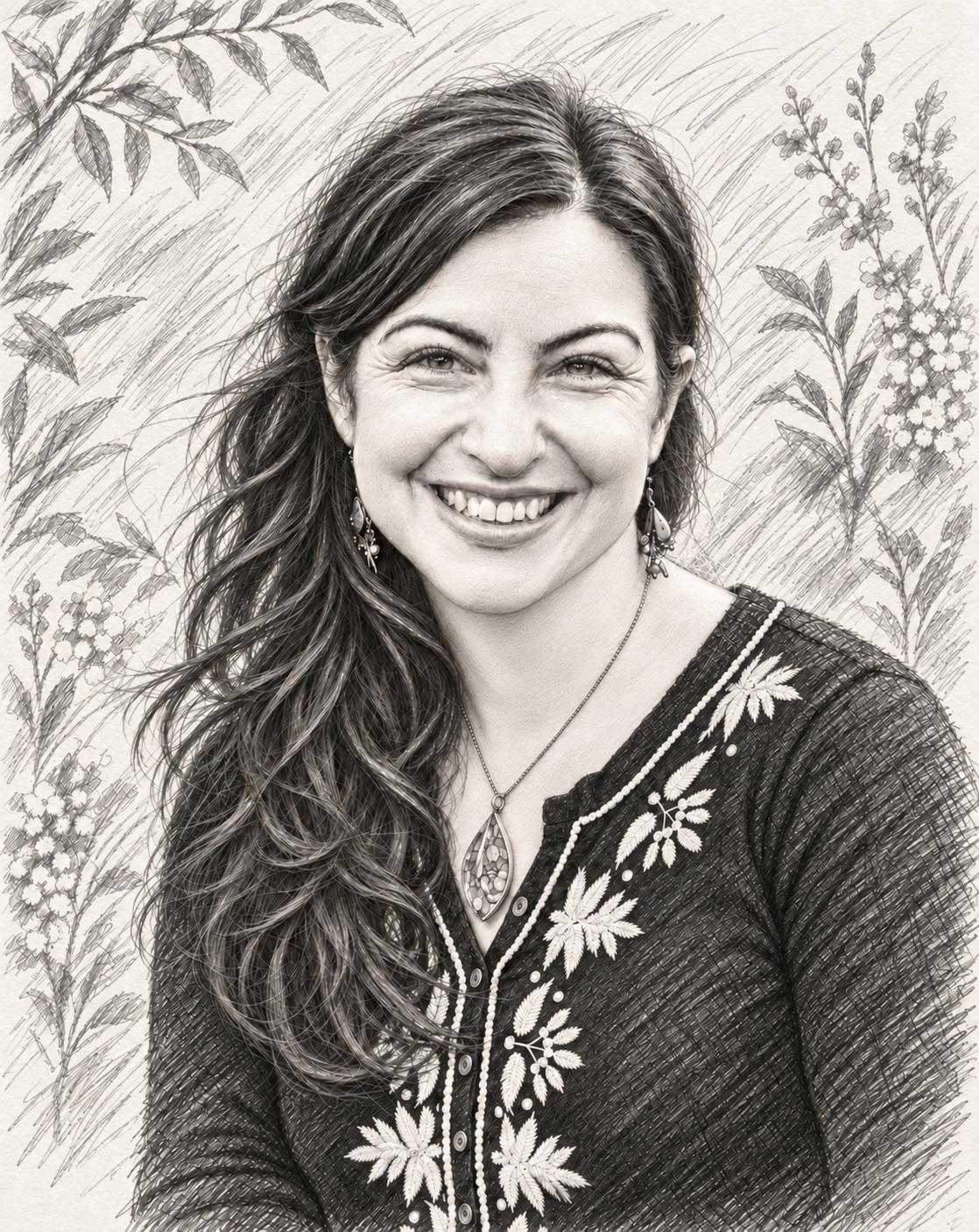
Southern California’s seasons do not always announce themselves dramatically. For Samantha Sirota, they arrive in food: a late grapefruit in March or April, carrying the scent of approaching summer; the first peaches; blueberries from the Central Coast that may appear in November, January or March, depending on what the weather has allowed.
For sixteen years, she has watched those arrivals travel from local farms into Good Box Organics boxes and onto family tables across Los Angeles. In that time, the produce has become a kind of record, not only of rain and heat and changing harvests, but of the lives unfolding around it.
The first Good Box deliveries went to parents at her father’s preschool. Their children were three feet tall. Today, those children are in college, and some of their families still receive a box.
Samantha pictures them growing to six feet on sixteen years of peaches, greens, citrus, squash and whatever else the farms were ready to send. “We nourished these kids through their entire childhood,” she says, smiling.
The children grew, and the boxes evolved with the seasons, shaped by what the farms had to offer. Holding the two together has required the same discipline that guides Samantha’s work: paying close attention to what is here, using it well and remaining flexible enough to change with it.
Learning to Notice
That attention began long before Good Box. Samantha was seven when her mother started taking her to farmers markets, but curiosity about food was already part of the family. Her grandmother had been making raw vegan food since the 1960s, subscribing to cooking magazines and bringing unfamiliar ingredients into the kitchen. She cared deeply about clean food and approached it as something to explore.
When Samantha was eighteen, an aunt who had attended culinary school taught her to make soups, stews, and hummus, to balance flavors and to cook with “a lot of love.” From the women in her family, she learned to go to the source, stay open to discovery and understand that feeding people is always personal.
Art deepened that instinct. For Samantha, art begins with noticing what surrounds you. She sees beauty in the intricate layers of a red cabbage and in the colors that announce a season: autumn’s reds, purples and auburn; winter’s squash, roots and carrots; spring’s greens, lemons and “zesty, bright things.” The year Good Box began, she painted fruit.
Food gave her a living palette. It changed from week to week, disappeared and returned, and asked to be met on its own terms. Long before she built a business around the harvest, Samantha was learning to see seasonality as both a constraint and a source of beauty.
Her path to Good Box began at a farmers market, where she volunteered in high school to complete community-service hours and stayed because she loved the farmers and the food. Only after leaving California for college in Chicago did she understand how much she had taken for granted. The apples were mealy. Persimmons could cost eight dollars a pound.
Back in California and short on money, she worked for a farmer she calls Farmer Gene in exchange for fruit, then traded some of it for vegetables, bread and hummus. Good Box grew from that small circle of exchange: work for food, food for food, and trust among people who knew where everything came from.
A job with a sustainable construction company gave the idea a larger frame. A house, she realized, is built once, while food asks us to choose several times a day, and every one of those choices touches both the body and the world beyond it. What had begun as an instinct became a mission. Good Box offered a place to bring together, as she puts it, “science and the earth and art and trying to help people.”
What Tomorrow Asked
The romance of seasonal food did not spare Samantha the mechanics of running a business. She had to learn payroll, accounting, refrigeration, warehouse operations and delivery logistics. In the early years, she and her husband, Mark, woke at four in the morning and did everything themselves; Samantha drove a cargo van loaded with three hundred boxes. She no longer loads every one herself, but the work still begins before dawn, and several members of the team have been beside her for more than a decade.
Seasonal uncertainty was familiar. The uncertainty that arrived with COVID was of another order. Samantha was in her first trimester, no one knew whether Good Box would be allowed to operate, and keeping the staff safe raised questions for which there were no established answers. Then, within a week, orders nearly doubled. Good Box paused its website, hired people, found more refrigeration space and coordinated with farms whose restaurant customers had disappeared overnight.
The demand kept the business moving, but adapting to it was “mind-numbingly hard,” she recalls. Unable to solve the whole crisis at once, Samantha narrowed her focus to the next decision in front of her. Each morning, she returned to one question.
What is tomorrow asking of us?
The question returned in May 2026, when a fire came within roughly a quarter mile of the warehouse and the vans. Good Box evacuated for five days and lost a week of deliveries. Samantha refunded every order while wondering how she would pay the staff.
Then dozens of families sent their refunds back so Good Box could cover employee wages.
“We give a lot,” Samantha says. “To receive that gift back from people felt really touching.”
The business had begun with people trading food and labor at a farmers market. Years later, that same spirit of reciprocity was still holding it together, this time flowing back from the families who had been nourished by the boxes to the people who packed and delivered them.
Dancing With the Seasons
Reciprocity holds the community together; seasonality determines its daily work. Good Box now works with about seven farms each week. Produce travels directly from the fields to the warehouse, where the team builds each box around what is actually growing, then sends it across Los Angeles, from Marina del Rey to Pasadena, Westlake, Granada Hills and Porter Ranch.
No two weeks are quite the same because the season itself is never fixed. “The essence of what we do is dancing and moving along with the seasons,” Samantha says.
That movement makes anticipation part of the pleasure. Samantha calls herself a “persimmon crusader,” determined to win more affection for a fruit she considers an unsung hero. Plums are even more elusive—abundant one year, nearly absent the next—and their scarcity only intensifies the pleasure of their return. “There’s something about the longing,” she says, “that makes it feel really special.”
But longing has begun to carry a different weight. After sixteen years, Samantha can see familiar rhythms becoming harder to predict. Stone fruit has started in April instead of May. Pears have arrived in July. Heat, rain and changing conditions move the harvest windows from one year to the next, making close attention more necessary than ever.
For families, seasonal eating means accepting some of that uncertainty. A household may hope for broccoli and receive squash instead, but the substitution is not arbitrary: it reflects what a farm was able to grow. The family still receives fresh food, and the farmer still has a market for the harvest.
Sustainable eating means moving with the seasons and welcoming what nature provides. “It’s the ebb and flow of nature doing her thing,” Samantha says.
She encourages children to meet unfamiliar food with the same openness. A vegetable can appear on the plate without becoming a test; a garden, another child’s appetite or a different preparation can often do more than persuasion. Kale becomes a crisp chip. Vegetables folded into a quiche lose their strangeness. Curiosity has room to grow when the pressure disappears.
What the Seasons Have Taught Her
Sixteen years of working closely with local farms have taught Samantha that living with the seasons begins in attention and ends in adjustment. You notice what is growing, enjoy it while it is here and change course when heat, rain or a late harvest alters what a farm can provide.
The same ethic runs through Good Box. Five percent from every delivery go back to partnering schools. Employees take produce home; edible surplus reaches the community through Together We Thrive; scraps are composted rather than discarded. None of these acts is grand on its own. Their meaning lies in repetition—in the way a modest choice, made week after week, can change where food goes, who benefits from it, and how local farms are supported.
“A lot of little things add up to something big,” Samantha says.
COVID made the dependence among farms, Good Box and its families impossible to overlook. Restaurants closed and growers suddenly lost a major outlet for their harvest just as families needed a dependable way to receive fresh food at home. Good Box continued moving food directly from one to the other, allowing farms to keep harvesting while families received what the fields could provide.
The crisis did not create that interdependence; it revealed it. The box is the object that passes from hand to hand, but the work endures because every part of the system makes room for the others: farmers adjust to the weather, the team adjusts to the harvest, and families welcome what arrives.
For Samantha, that may be the deepest lesson of the seasons. Nature will not become predictable, but people can respond to change with flexibility, trust and generosity.
“We need the farmers. They need us,” Samantha says. “We just need each other.”
What She Inspires in Us
Samantha inspires us to pay closer attention—to the changing colors and flavors of the seasons, the beauty within the food we eat, and the people and land behind every ingredient. She helps us see food as both nourishment and art, and reminds us to be mindful of what we consume, respect nature’s rhythms and value the farmers and communities who sustain us.